01
Friendship
A relationship begins with a pledge to treat one another as partners, not obstacles.
A relationship strong enough to hold two vessels together—and honest enough to admit when rust has formed.
The speaker moves from a personal search for truth and a bodyworker’s attention to nervous systems, toward a political memory of treaty-making. The bridge is deliberate: individuals can enter fight, flight, freeze, or appeasement; peoples can do something similar when a relationship is neglected or made unsafe.
The covenant chain becomes the larger image. Its links are not merely historical objects. They are obligations: to meet in a good mind, keep communication open, guarantee safe passage, address harm fairly, and return to the relationship before the wound hardens.
This is not a clip built to extract one quotable idea. The presentation takes its time: lived experience becomes a way into collective nervous systems, treaty protocols, the Two Row Wampum, and the Covenant Chain.
A relationship begins with a pledge to treat one another as partners, not obstacles.
Gather with the mental and emotional conditions needed to hear, deliberate, and reach one mind.
Peace is the active condition the first two links are meant to protect—not the silence after conflict.
When harm or neglect creates rust, name it, compensate where necessary, and renew the bond.
These are not chapter claims imported from elsewhere. They are signposts from the video’s own sequence.
“Roots of a Nation”: an accidental, peaceful revolution begins with a search for truth.
play ↗The individual nervous system becomes a way to think about the collective.
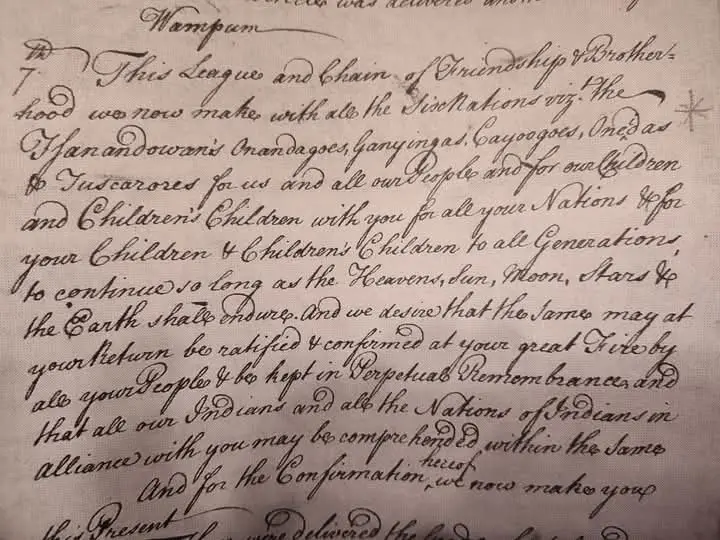
play ↗An inherited manuscript and oral history carry the path through the chain.
play ↗The rope gives way to the chain: three links become friendship, good mind, and peace.
play ↗Rust appears through inattention, injury, deception, and broken obligations.
play ↗The remedy is concrete: address the wound, administer justice fairly, replant the tree of peace.
play ↗